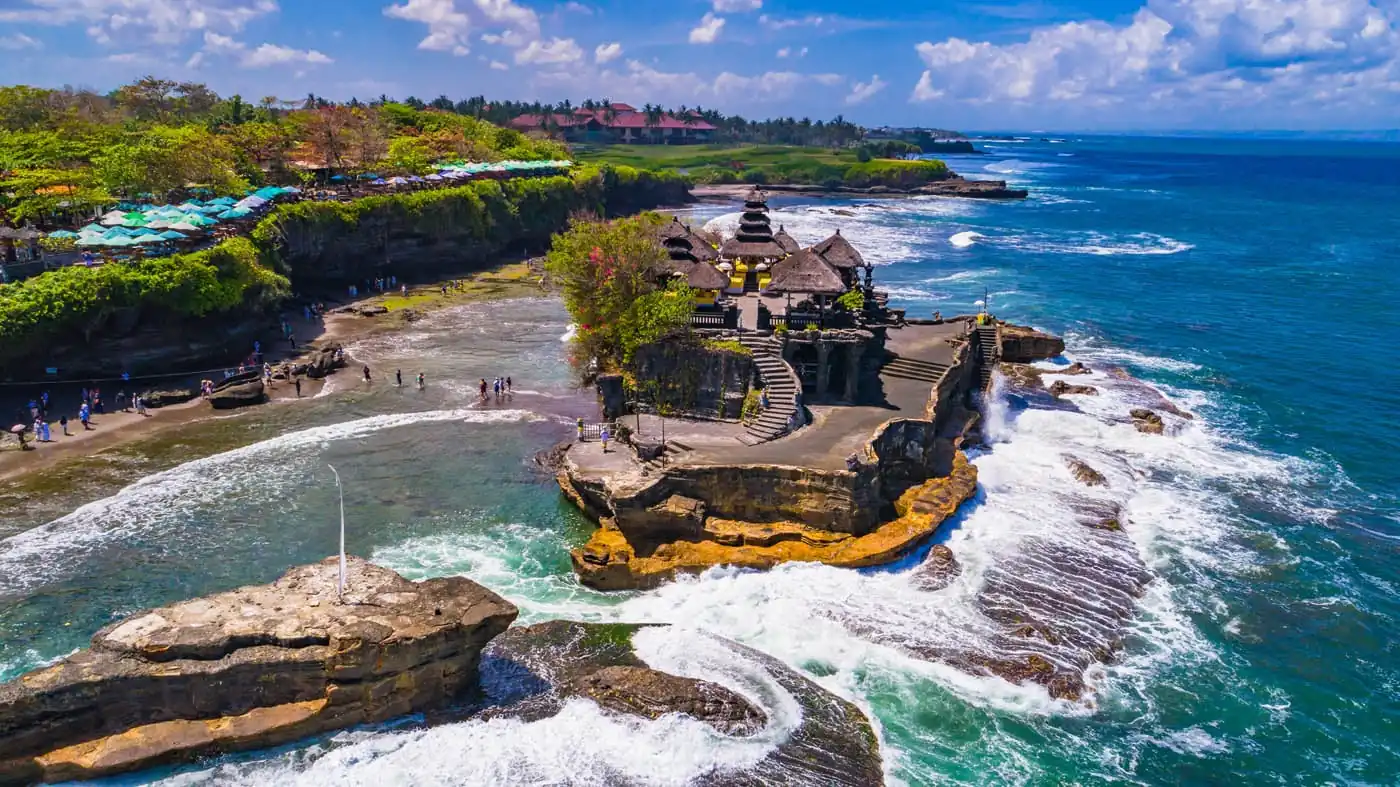
Have you ever wondered about the history and spiritual meaning of Tanah Lot Temple? As a famous temple in Bali, Tanah Lot is not only an iconic tourist destination but also holds deep spiritual value. Standing on a rock surrounded by the sea, this temple has been a center of worship and a spiritual symbol for Balinese Hindus for centuries.
In this article, you will discover the origins of Tanah Lot Temple, the legends surrounding it, and its role in the culture and life of the Balinese people. If you want to understand more about the history of Tanah Lot before visiting, read on!
History of Tanah Lot Temple and Its Origins
The Spiritual Journey of Dang Hyang Nirartha
The history of Tanah Lot Temple begins with the spiritual journey of Dang Hyang Nirartha, a Hindu priest from Java who came to Bali in the 16th century to spread Hinduism. At that time, Bali was ruled by King Dalem Waturenggong, who supported the spread of Hinduism throughout the island.
"According to historical records, Dang Hyang Nirartha played a major role in the spread of Hinduism in Bali. He established various temples along the coast, including Tanah Lot Temple, as part of his effort to spread Hindu teachings on the Island of the Gods. Among the Balinese people, he is better known as Pedanda Sakti Wawu Rawuh."
Beraban Village, Tabanan: The Beginning of Tanah Lot
During his spiritual journey, Dang Hyang Nirartha saw a holy light coming from the southern sea. Intrigued, he followed the light until he arrived at Beraban Village, Tabanan, and found a rock shaped like a parrot by the sea. Feeling this place had strong spiritual energy, he meditated on the rock.
At that time, the leader of Beraban Village was Bendesa Beraban Sakti, who rejected the Hindu teachings brought by Dang Hyang Nirartha. Bendesa Beraban Sakti was displeased because many villagers began to be attracted to the new teachings. He and his followers tried to expel the priest while he was meditating on the rock. However, the extraordinary events that followed changed everything.
The Legend of the Holy Snake Guardian
According to legend, when Bendesa Beraban and his followers tried to expel Dang Hyang Nirartha, the priest waved his sash. Instantly, a poleng snake (a snake with a black-and-white pattern) appeared and attacked them. This event shocked Bendesa Beraban and made him realize the priest's spiritual power.
Since then, the Balinese people believe that this holy snake is the spiritual guardian of Tanah Lot Temple, symbolizing protection and balancing the energy around the temple. Until now, visitors can still find these snakes hiding in the crevices of the rocks. The species is the Banded Sea Krait (Bungarus candidus), which has a distinctive black-and-white pattern. Although revered as a temple guardian, this snake is highly venomous, so visitors are advised not to disturb it.
The Legend of Moving the Rock to the Sea
Not only creating the holy snake, Dang Hyang Nirartha also demonstrated his power by moving the rock where he meditated to the middle of the sea. This happened after he felt disturbed by the expulsion attempts.
With his spiritual power, the rock shifted into the sea, creating a holy place later known as Tanah Lot. In Indonesian, "Tanah Lot" means "land in the sea". This miracle shook the beliefs of Bendesa Beraban and his followers, who finally accepted Hinduism and followed Dang Hyang Nirartha's guidance. Since then, Tanah Lot Temple has served as a place of worship for Dewa Baruna, the sea god in Balinese Hinduism.
The Sacred Kris and Spiritual Heritage
Before leaving Beraban Village, Dang Hyang Nirartha gave a sacred kris (traditional dagger) to Bendesa Beraban as a symbol of protection and blessing for the community. This kris is now kept in Puri Kediri and becomes part of the religious ceremonies routinely held at Tanah Lot Temple every six months.
Religious Rituals and Ceremonies at Tanah Lot
One of the biggest ceremonies at Tanah Lot is Piodalan, the temple's anniversary celebrated every 210 days based on the Balinese Pawukon calendar (Budha Wage Langkir). In 2026, the Piodalan is scheduled for July 1st. The next Piodalan in 2027 is scheduled for January 27th.
On this day, thousands of Hindus from all over Bali come to pray. Besides Piodalan, several other important rituals include:
- Daily Prayers: By locals to seek protection and prosperity.
- Melasti Ceremony: Held before Nyepi Day, where Hindus bring sacred objects to the sea to be purified.
- Fishermen Rituals: As a form of seeking safety before going to sea.
Conservation Efforts
Because it is constantly pounded by waves, the temple experiences natural abrasion. To preserve it, since 1987, the government has made conservation efforts, including installing breakwaters and structural reinforcements.
Religious Tourism Around Tanah Lot
Besides Tanah Lot, there are several religious destinations nearby, such as Batu Bolong Temple, which sits on a cliff overlooking the sea. For the best holiday experience at Tanah Lot, check out these guides:
- Tips for Visiting Tanah Lot Temple → Get a complete guide to enjoy your visit comfortably.
- Tanah Lot Entrance Ticket Prices → Know the latest ticket prices before visiting.
- Tanah Lot Holiday Itinerary → Find the best recommendations to explore Tanah Lot.
- Tanah Lot Tour Bali: Cheap Holiday Packages → Explore affordable and exciting tour packages.
Want to Visit Tanah Lot Hassle-Free?
The journey to Tanah Lot takes 1-2 hours and is prone to traffic jams. Don't let the stress on the road ruin your sunset moment. Rent a car + private driver starting from just IDR 550,000. Our driver will take care of the roads & parking, you just sit back and relax!